by Judy | Mar 23, 2016 | Project, Volunteering
The Chilterns Chalk Streams Project in partnership with Chiltern Rangers CIC, the Environment Agency and a hardy bunch of volunteers completed work to improve habitat along a 150m long section of the river adjacent to Bourne End Recreation Ground in March.
The river at this location had become degraded through past management practices which had led to it becoming straightened, over-wide and heavily shaded by bankside trees. As a result the river lacked the habitat features normally associated with healthy chalk streams.
To address this, the CCSP working with partners under the banner of Revive the Wye, a local community initiative dedicated to improving the condition of the river, developed a plan to restore the river for the benefit of fish and other wildlife.
Read more

by Judy | Jan 4, 2016 | Project
Excerpt from Environment Agency West Thames Fisheries Autumn Round-up 2015 – Low cost fish passes.
Many weirs represent a barrier to fish passage; including those within the Environment Agency’s hydrometric network. Most of the impounding structures within the H&T network are Crump or triangular-profile weirs.
Traditional solutions to fish passage problems at weirs and dams have normally been purpose-built to provide favourable hydraulic conditions for fish swimming in the upstream direction. Typical solutions include bypass channels, Larinier fish passes, brush passes and pool traverse passes. Such fish passes can be expensive to build, especially when added to an existing structure. They can also have a detrimental impact on the ability to gauge flows.
In response to the need for an alternative, low-cost strategy, which enables accurate flow gauging, a three-year research project into low cost modifications to the Crump weir to improve fish passage was undertaken.
This research led to the development of ‘low cost baffles’ which can be bolted on to existing structures to facilitate fish passage without any impacts on flow gauging. Low cost baffles can also be applied as an interim measure on ‘non-gauge’ weirs, or weirs where other fish pass solutions will be difficult to develop/achieve. In these instances low cost baffles provide a fish ‘easement’ until an opportunity for a alternative solution arises, or while a preferable, multi-species and multi-age class pass, is developed.
Pre-fabricated baffles can simply be retro-fitted to existing structures in a formation that is set using a standard equation. By gathering simple measurements from each impounding structure the low cost baffle solution can be applied to a wide range of crump weirs in a fashion that has been tried, tested, and approved by Fisheries and by Hydrometry & Telemetry Nationally.
by Judy | Aug 14, 2015 | Volunteering
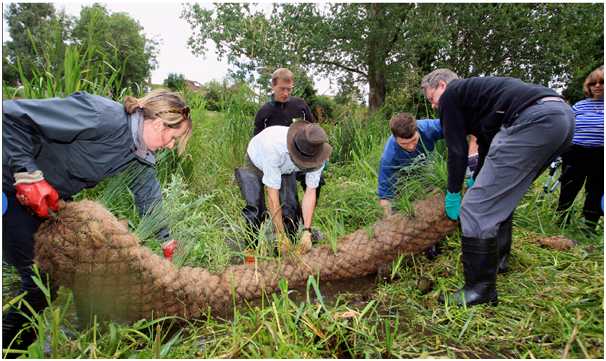
On Thursday 30th July about 25 people from DEFRA came to Desborough Park for a corporate volunteering day organised by the Revive the Wye Project. Four RTW task leaders were assisted by members of the Environment Agency and Wycombe District Council and the work parties completed all the planned tasks in and around the river with energy and enthusiasm. The day was considered a great success by all involved. The Bucks Free Press sent a reporter to follow the event and the report can be viewed here.
by Judy | Jul 15, 2015 | Volunteering
Funges meadow volunteers
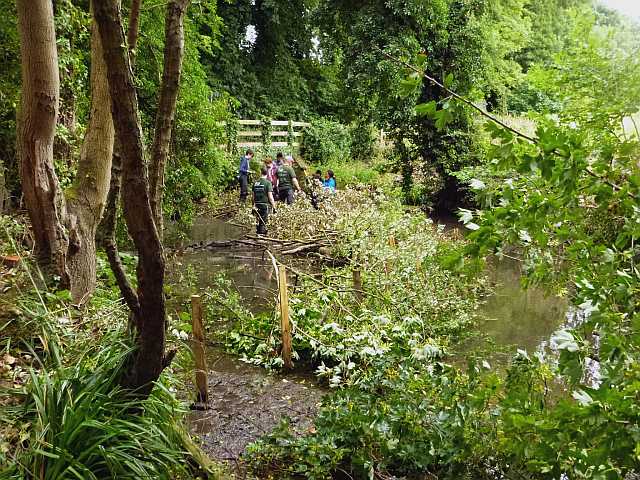
Funges Meadow has had a makeover. On Monday 29th June, Tuesday 30th June and Wednesday 8th July, a small number of RTW volunteers, along with numerous corporate volunteers, turned up at Funges Meadow Nature Reserve to help with tasks organised and supervised by the Chiltern Rangers to improve this riverside reserve. On the Monday and Tuesday afternoon only sessions, most of the RTW input was devoted to pulling massive quantities of Indian Balsam, which although not adjacent to the river, was near enough to become a problem in future, unless dealt with prior to seed dispersal. On the final all day session, the RTW volunteers helped with a major task of narrowing the stream bed alongside Bowden Lane to speed up the flow and, by doing so, to disperse the deep layer of silt on the riverbed. The task involved creating a mid stream barrier of brush cuttings and fixing it in place with posts driven into the stream bed and wiring in thicker tree branches to prevent the brush cuttings being swept away.”
by Judy | Jul 15, 2015 | Volunteering
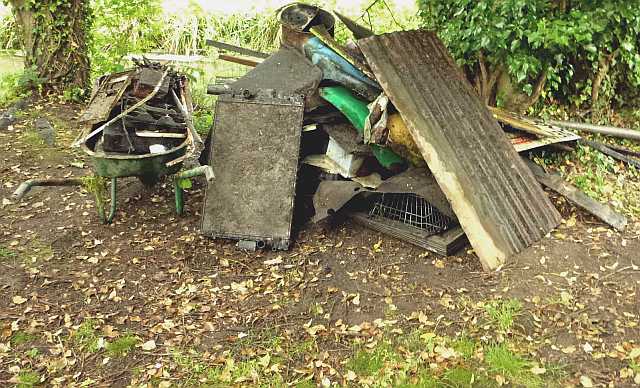
On Saturday 13th June, a small number of local residents turned up by the Wye where it flows through the Wye Dene housing development, to remove some of the rubbish from the river. A RTW volunteer task leader attended in the capacity of task leader, trainer and advisor, the idea being that the local residents would be able to organise and undertake similar tasks themselves when they felt they were ready to do so. Following the good practice of working upstream, so that objects on the riverbed are not obscured by disturbed silt, a decision to start where a path, regularly used by Wye Dene residents, leaves the Wycombe Marsh Retail Park resulted in some very bulky items of rubbish being taken out of the river. The afternoon went very quickly, and there was insufficient time to remove all the rubbish in the river, so it was agreed to concentrate on the most obvious items, and arrange another task at a later date.
