by Judy | Mar 23, 2016 | Project, Volunteering
The Chilterns Chalk Streams Project in partnership with Chiltern Rangers CIC, the Environment Agency and a hardy bunch of volunteers completed work to improve habitat along a 150m long section of the river adjacent to Bourne End Recreation Ground in March.
The river at this location had become degraded through past management practices which had led to it becoming straightened, over-wide and heavily shaded by bankside trees. As a result the river lacked the habitat features normally associated with healthy chalk streams.
To address this, the CCSP working with partners under the banner of Revive the Wye, a local community initiative dedicated to improving the condition of the river, developed a plan to restore the river for the benefit of fish and other wildlife.
Read more

by Judy | Jan 4, 2016 | Project
Excerpt from Environment Agency West Thames Fisheries Autumn Round-up 2015 – Low cost fish passes.
Many weirs represent a barrier to fish passage; including those within the Environment Agency’s hydrometric network. Most of the impounding structures within the H&T network are Crump or triangular-profile weirs.
Traditional solutions to fish passage problems at weirs and dams have normally been purpose-built to provide favourable hydraulic conditions for fish swimming in the upstream direction. Typical solutions include bypass channels, Larinier fish passes, brush passes and pool traverse passes. Such fish passes can be expensive to build, especially when added to an existing structure. They can also have a detrimental impact on the ability to gauge flows.
In response to the need for an alternative, low-cost strategy, which enables accurate flow gauging, a three-year research project into low cost modifications to the Crump weir to improve fish passage was undertaken.
This research led to the development of ‘low cost baffles’ which can be bolted on to existing structures to facilitate fish passage without any impacts on flow gauging. Low cost baffles can also be applied as an interim measure on ‘non-gauge’ weirs, or weirs where other fish pass solutions will be difficult to develop/achieve. In these instances low cost baffles provide a fish ‘easement’ until an opportunity for a alternative solution arises, or while a preferable, multi-species and multi-age class pass, is developed.
Pre-fabricated baffles can simply be retro-fitted to existing structures in a formation that is set using a standard equation. By gathering simple measurements from each impounding structure the low cost baffle solution can be applied to a wide range of crump weirs in a fashion that has been tried, tested, and approved by Fisheries and by Hydrometry & Telemetry Nationally.
by Judy | Jul 15, 2015 | Project
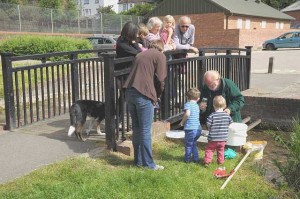
Revive the Wye volunteers are already monitoring 3 sites on the Wye and one of its back-streams. We want to recruit and train more volunteers so that we can regularly monitor more sites.If you are interested please contact us.
Local interest
This photo shows the typical level of public interest in what we are doing when we are sampling next to the footbridge in Fryers Lane.
See our
projects page for an explanation of Riverfly monitoring and more pictures.
by Judy | Apr 24, 2015 | Project
We are delighted that the first phase of some exciting developments at Funges Meadow Nature Reserve has been completed This work was made possible with the help of £12,000 of external funding secured by Revive the Wye as part of an innovative partnership between Revive the Wye and Chiltern Rangers to develop the Funges Meadow Nature Reserve in High Wycombe as a centre for environmental awareness about the River Wye and for practical training for RTW volunteers and supporters (Friends of the Wye). Access to Funges Meadow is controlled by arrangement with Chiltern Rangers to RTW and other local community groups with which Chiltern Rangers work.